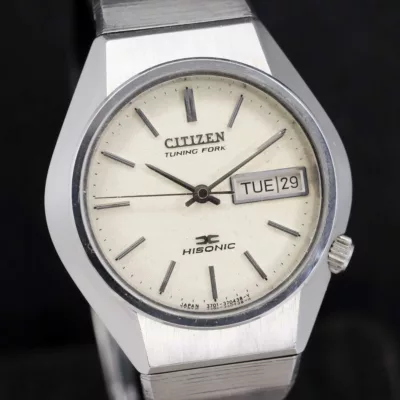
Tuning fork
A tuning fork movement is based on a battery powered transistor circuit that keeps a tiny metal tuning fork vibrating continuously at a fixed frequency.
The mechanical coupling is allowed by two tiny jeweled pins (or “fingers”) that are attached to the tines of the tuning fork. As the fork vibrates, these pins engage the teeth of a tiny index wheel (a finely toothed ratchet gear), advancing it one tooth at a time with each vibration cycle.
The concept was invented by a Swiss engineer but it is a US based manufacturer that developed it and made it popular : Bulova. A few brands followed the trend in proposing some tuning fork models, before quartz movements took a significative advantage : Omega, Universal Genève, Longines, Zénith (ESA movement), Citizen.
Showing the single result